by Ethan Boecher*, Summer Research Fellow
This summer I found myself sitting with a friend, not at a desk, not in a meeting, just talking, rattling off statistics about the North Country. Population decline. Aging business owners. A quality of life index falling year after year. I was rambling to no greater point when he half-jokingly cut me off and laughed, “So when do you get to the good news?”
I did not have a quick answer to his question, and that bothered me.
As a research fellow partnered with ANCA’s Small Business team, my work was centered around the North Country Center for Businesses in Transition (CBIT), an ANCA-led partnership initiative focused on helping transitioning business owners pass their businesses on rather than shut their doors. I spent much of my summer in databases and Google sheets, collecting and translating economic data on small businesses and communities across the North Country’s 14 counties. Using tools like the CORI regional data platform and ANCA’s own small business data (from the U.S. Census Bureau’s Annual Business Survey), I built county-specific profiles tracking everything from owner age and education to GDP per capita and quality of life trends. My objective was to help CBIT liaisons make the case for why succession planning matters, and why the region’s small businesses are worth fighting for.
The data is sobering. More than 60 percent of business owners in many counties are 55 or older. Business counts are falling while state and national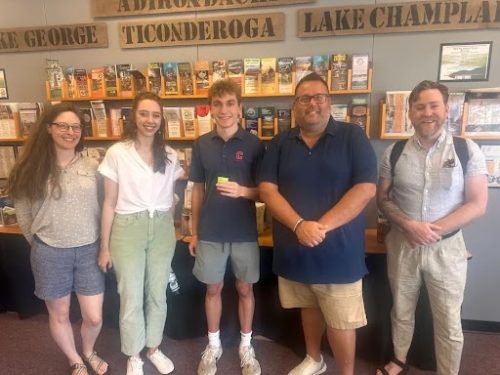
 numbers climb. Quality of life rankings have dropped significantly since 2010. If you read those numbers in isolation, the story they tell is one of a slow decline, yet exacerbated since the 2020 pandemic.
But here is what I kept missing: data is not the story. It is a building block for one. The framing of a story you choose to build with it is up to you.
When I presented a draft of my county infographics to my team, the feedback was consistent. I got the facts right with extensive amounts of data, but the framing was pulling people toward helplessness rather than action. Soften this. Reframe that. Focus on what is possible, not just what is at stake. Most of these edits were small, but the point behind them was not. CBIT’s work depends on people feeling like they can do something. A conversation between a retiring business owner and a CBIT liaison should lead with opportunity, not crisis. Getting the framing right wasn’t a stylistic choice, but the whole point.
The North Country’s small businesses are not just economic units. Thirty-six percent are family-owned, which is nearly double the state average. Nearly 80 percent of owners say their business is their primary source of income. Around 30 percent say that carrying on their family business is important to them. Looking past any economic metric, these are not more grim statistics, these are evidence of the fact that people do care and want to act.
The irony of the story: I had focused so much on the potential risk and decline, I almost ignored the success stories literally in front of me. It was through various trips to Saranac Lake and Ticonderoga that I got to shake hands and talk with the business owners whose transitions CBIT had helped succeed. What convinced me of the North Country’s opportunity was not a spreadsheet, but it was seeing the work ANCA and CBIT partner organizations have done with real businesses in real communities. 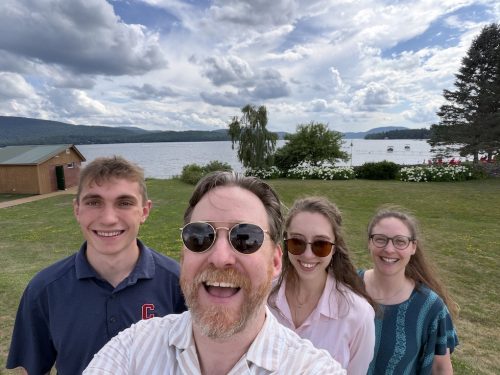
My friend’s offhand comment and my team’s feedback were pointing at the same thing: when you put effort into describing an impending crisis to be scared of, rather than a pivotal opportunity for change, you lose people. When you lead with what matters to the people of a community and show the pivotal role small businesses play, you give people somewhere to put their energy.
The work that ANCA’s Small Business team and the CBIT partnership do is what gives me confidence in our North Country’s progress and development in the future. I’m extremely grateful for the small business team, all of ANCA, CBIT liaisons, and the small business owners who have all given me experience and perspective on the state of the North Country. I’ve developed a more nuanced understanding of the role data plays in not just being a story, but telling a story. Above all, I’ve learned more about our North Country’s story and have hopefully contributed to helping tell it better.
Photos: Top: Ethan, center, learned from Ticonderoga Area Chamber of Commerce President & CEO Matthew Courtright during a visit with this key CBIT partner. Bottom: Ethan, left, and ANCA’s Small Business team (Zach, Mahala and Lauren) during their visit to Hamilton County
*Ethan Boecher is a student at Cornell University studying Applied Economics & Management engaged in the Dyson Grand Challenges Impact Internship program. This past summer, Ethan worked with ANCA’s Small Business team to strategically strengthen and advance our Center for Businesses in Transition (CBIT) efforts. We are grateful for his hard work, insights and contributions to our programs.