
by Jill Henck
As ANCA’s Climate & Energy Program Director, transitioning my personal vehicle from a hybrid electric to a full electric has been on my mind for a while. I’ve been an electric vehicle (EV) driver for around six months now, and I would like to share my lessons learned.
This past September, I decided to upgrade from my 2011 Prius (with 260,000 miles) to a used EV. Many factors contributed to this decision, but the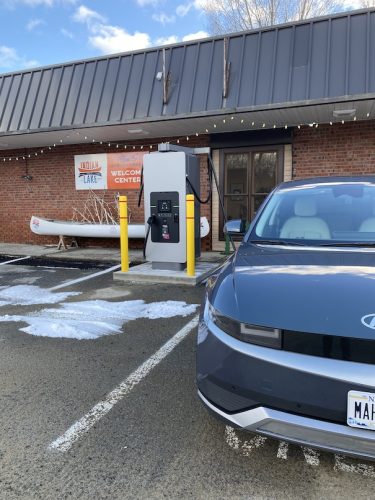 timing was influenced by the used-EV tax credit expiring at the end of September 2025. After extensive research, I determined a used Hyundai Ioniq 5 AWD was the car for me.
To qualify for the incentive, it had to be at least two years old and less than $25,000. I also limited my search to qualifying dealers who could offer the incentive off the sticker price, as opposed to processing it myself. I quickly learned that I was one of many trying to buy an EV before the federal incentives expired, and I had a heck of a time finding a vehicle that met all my needs.
After a lot of research, perseverance, and help from my friends, I found my unicorn and brought home my 2022 Ioniq 5. I am fortunate to have a handyman husband and brother-in-law who installed an Emporia Level 2 charger in our garage for a total cost of around $700 (our electrical panel did not need to be upgraded).
Overall, this car is great. It’s roomy, handles really well in the snow, and meets all of my local driving needs. The only real qualms I have with this vehicle are related to design and not drivetrain. I should mention these are also issues related to North Country winter living. First, and most annoying, ice dams form around my windshield wipers that prevent them from wiping. Second, (this is not really bothersome but rather, it’s an observation) the door handles pop out when the doors are unlocked. So if snow gets into that crevice, the handles can’t go back in. Every vehicle has some quirks though, and fortunately, these are not deal-breakers for me.
The warm weather range of my Ioniq 5 is 256 miles. Lithium-ion batteries take on and put out less energy in colder conditions because of slowed chemical reactions. As a result, in sub-zero temperatures, my 100% charge is around 200 miles without turning on the heat. If I turn my heat on, my range decreases to around 180 miles on a full battery.
When I was researching vehicles, I wanted to be able to drive from my home in Rainbow Lake to my parents’ house near Utica — approximately 150 miles — without having to stop and charge. This is still entirely possible — even with a reduced range in the winter. That said, traveling to Utica is not a challenge because I can charge to 100% at home. However, my parents are not equipped with a Level 2 charger, so I need to rely on other charging options to replenish my battery for the trip home.
If I’m staying a few days, I can plug in my portable Level 1 at my parents’ and use their electricity like the good old days. If I’m not, I need to utilize DCFCs in the area (note that many EV drivers will only charge to 80% on a DCFC to preserve the health of their batteries).
 My first choice for charging is to top off on the way there and back at the free DCFCs at Indian Lake’s Welcome Center (pictured above). These chargers, and subsequent free charging, were funded through the DEC’s Zero Emission Vehicle Infrastructure grant program for municipalities. Before these came online in October 2025, I would stop at the Ford Dealership in Utica and charge at their DCFC and then follow my usual route through Old Forge to return home. Since these chargers became operational, I’ve adjusted my behavior to drive through Indian Lake instead. Typically, we charge long enough to use the restroom, browse the welcome center, shop a bit, and chit-chat. By the time I get everyone buckled up, I’ve added around 80-100 miles of range.
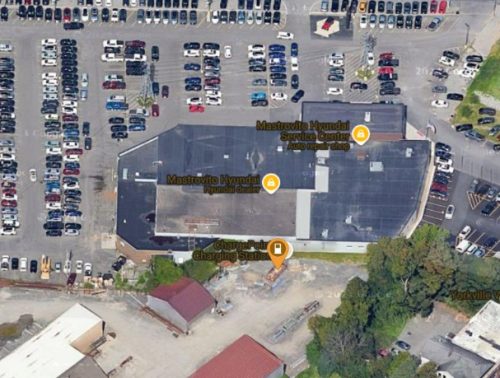
When traveling, I primarily use the PlugShare app to find chargers and check their availability. This is best done ahead of time because, as I’ve discovered, some pins on the Plug Share map may take you to abandoned warehouse parking lots instead of a DCFC. I’m talking about you, Mastrovito Hyundai Charge Point Stations (see image).
Another consideration when charging on the road is preconditioning your battery. To take advantage of fast charging capabilities, the battery needs to be warm enough to take on power quickly. In the 2022 Ioniq 5, you must use the vehicle’s own navigation system to select the charging destination so it can precondition (warm) the battery en route. Preconditioning allows the vehicle to take on that faster charge right away. Otherwise, your promised 18 minutes to 80% charge at a DCFC is more like 40 minutes.
A few additional points about charging outside the home: I recommend checking the availability of chargers ahead of time to make sure they’re functioning, including checking the comments on the PlugShare app. Often, DCFCs are located at car dealerships, and more than once, I’ve seen them available on the app and blocked by gas vehicles upon arrival.
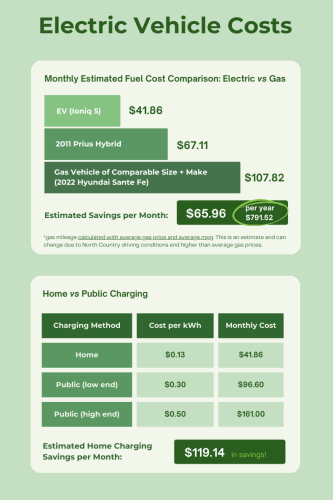 Like many EV drivers, I do the majority of my charging at home. I’m a North Country National Grid customer, and this is by far my cheapest option for charging. Even with January’s jump in supply cost, my average electricity costs (if I average supply and delivery prices) is $0.13 kWh. Charging outside the home, the price is usually between $0.30-0.50 per kWh.
OK, what the heck does that mean? I’ve driven approximately 5,000 miles since I purchased my vehicle, so we’ll call that 1,000 miles a month. After comparing my National Grid bills to last year’s (and averaging supply and delivery costs), I’m averaging about 322 kWh more per month than last year. If we pretend everything else is the same, that’s about $60/month more than I paid last year. I have no data to compare to my fuel cost for my 2011 Prius, nor would I consider those figures comparable, since the Ioniq 5 is a significantly larger AWD vehicle.
For the most part, I’m an all-in EV driver with a few caveats and a safety net. I should mention that my household is fortunate enough to have two reliable vehicles, and one of them is a gas-powered Ford Maverick. We are road warriors, and when we travel long distances, we’re still taking the gas vehicle because of limited charging station (or electric vehicle supply equipment, EVSE) availability.
EVSE infrastructure has come a long way, and I am confident that I could make it work if I didn’t have time restrictions or small children. But the reality is, when you’re on the road for 12 hours or more, driving out of your way to find a DCFC is not incredibly appealing. Once every truck stop and gas station has a DCFC, that will be a different story.
For EV drivers traveling to the North Country, they will need multiple locations, along main thoroughfares, outside of Routes 87 and 81, to instill enough confidence to trek this far north, especially on our coldest days.
ANCA’s Climate & Energy team works with local governments to help navigate grant opportunities, like the DEC’s ZEV infrastructure grants. However, to achieve the redundancy needed for EV driver confidence, we need the private market to take charge of charging.
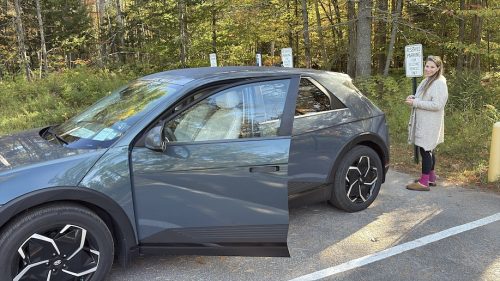
Jill with her Hyundai Ioniq 5