by Hadar Pepperstone, ANCA Climate Fellow
Since I became a Climate Justice Fellow at ANCA, I’ve learned a lot about energy in New York and the North Country, including the important role that battery storage could play. As we continue to discuss what battery storage looks like in the region, I wanted to share some of what I’ve learned in the last few months.
What is BESS?
Battery Energy Storage Systems (BESS) are large battery installations that connect to a home, business, or the larger electrical grid. As shown in the diagram below, BESS consist of cells, modules, and racks, which are then controlled with a Battery Management System (BMS). The BMS is the brain of the battery system and monitors the whole system down to individual cells.
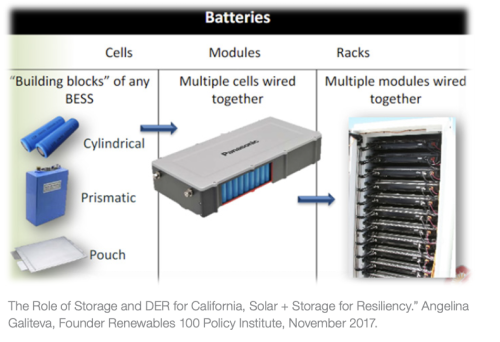
Components of a BESS
There are two options for BESS. First, it can be part of a renewable energy installation, like a solar farm, and be charged when more energy is being produced than the grid needs at that time. Then, when energy is needed, the batteries can send that stored energy to the grid.
The second option is a standalone BESS, meaning it is not “co-located” with clean energy generation. In this case, it charges directly from the grid when energy demand is low and costs are cheaper, before discharging when costs and demand are high.
Both of these options can help keep energy costs from spiking and reduce the need to turn on peaker plants, which operate when demand is especially high, are expensive to operate, and burn fossil fuels.
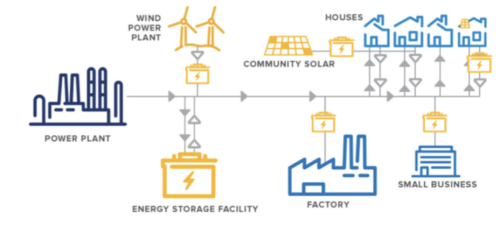
Diagram showing how battery storage can be integrated into the electric grid. (NYSERDA)
New York’s electric grid is facing strain due to increasing electricity demand and aging infrastructure. Adding BESS to the grid will support the grid by responding to energy supply and demand quickly and without burning polluting fossil fuels.
Day to day, BESS can help meet peak energy demand and create a balance of electricity supply. This is referred to as “peak shaving” since we’re “shaving” the top of the energy demand spike.
Long term, BESS can also reduce or defer the need for expensive grid infrastructure upgrades needed to meet future peak demand. Grid infrastructure upgrades contribute to increased delivery charges on your electric bill, and deferring or eliminating expensive upgrades would help keep costs down.
BESS and the North Country
In the North Country, we have lots of hydropower, as well as wind and solar, so I wasn’t sure at first why we would need batteries, too. But as we shift our reliance from fossil fuels, batteries are needed to enable the transition to renewables and energy independence.
By supporting the state-wide grid, batteries can improve energy affordability, as mentioned before, by supporting peak demand and reducing the need for more expensive grid upgrades. Just like your taxes go to paying for upkeep of the roads in your town, but you drive roads of other municipalities too, the energy made and used in the Adirondacks isn’t confined by the Blue Line. We’re part of the larger state-wide grid, and the system needs to be evaluated and supported as a whole.
There have been some BESS proposals made by developers in communities all over the state recently, including the North Country, such as part of a solar installation in Elizabethtown and standalone BESS in St. Armand. Developers look for locations based on factors such as size, local zoning, and avoiding sensitive environmental areas. Crucially, they also look for locations which have strong grid connections with enough extra energy that can be stored for later to be able to support additional infrastructure like a BESS, and there are some locations in the region that meet those requirements.
Fire Risks and Solutions
Historically, the main risk commonly associated with BESS, as with any electrical infrastructure, is fire. Fires can happen when components of the battery overheat, including by “thermal runaway,” where battery temperatures self-accelerate. Battery fires, especially lithium-ion batteries, which are currently the most common type used in BESS, are not like a house fire we may be more familiar with. For lithium-ion battery fires the recommended strategy is to monitor and let the fire burn itself out.
Obviously that sounds very scary, but studies have shown no lasting environmental impact on soil, air, or water after this type of fire, which I know is a concern for me, personally. Because of the unique nature of BESS fires, there are specific, detailed trainings for first responders that are required to be provided to EMS with BESS nearby.
For example, in 2023, in East Hampton on Long Island, the way that a BESS was handled led to PFAS contamination in local wells, but this was due to firefighters using water to suppress the fire and washing the built-in fire suppressant chemicals out of the system which would have been self-contained if not for the water used. This just goes to show how important site-specific training is.
Since 2023, there were four cases of BESS facilities catching fire in New York, such as in Warwick. As a result, the state has taken major steps to improve fire safety around BESS, including New York’s Inter-Agency Fire Safety Working Group, which created the new Fire Code of the State of New York. They gave 11 recommendations, including requiring “industry-funded peer review” of BESS projects and increased monitoring and fire detection, which were incorporated into the fire code and made it much more rigorous. For anyone interested, those documents and more can be accessed on their website.
There are also site-specific, annual trainings for first responders that are required to be provided to local EMS by the owner of BESS facilities for installations of a certain size. Technological advancements also mean that lithium batteries are safer than they were a few years ago. So fires that have happened at older BESS facilities are much less likely to occur in ones built today, as shown in the orange line on the graph below.
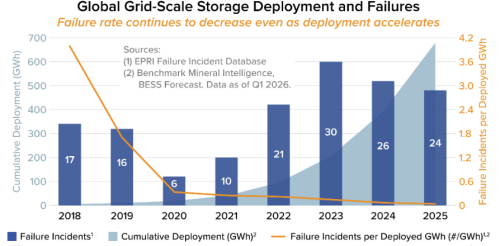
Graph showing proportion of BESS capacity deployed compared to number of failure incidents. (NYSERDA)
Status of BESS in the Region
Municipalities in New York have control over how BESS are handled in their community. Many communities have imposed a moratorium on BESS development to give themselves the time to gather information and study what the impacts of a local BESS facility would be. Legally, moratoriums can halt development for six or twelve months, and can be renewed up to two times. In fact, there have been moratoriums related to BESS imposed in nearly 40 municipalities across the North Country since 2023. Once a moratorium is implemented, the municipality should prepare for next steps.
Local governments can be proactive in managing BESS by working with the New York Department of State, municipal attorneys, regional planning agencies, internal staff and technical experts to create laws and zoning regulations that determine where they can be placed in a community.
Several communities in the North Country have already done this, such as Long Lake, the Village of Black River, and Town of Leyden. Some municipalities have also banned BESS altogether and is allowable per the local government’s homerule authority. That said, a complete prohibition could prevent opportunities for revenue, jobs, and other community benefits like having a reliable electric grid. It also may prevent small-scale BESS installations that could be beneficial to local businesses. Additionally, in July the Westchester County Supreme Court ruled that BESS counts a public utility, meaning that local bans may not hold up in court and then a community will be without adequate regulations for BESS.
What Next?
All of this information just scratches the surface of BESS, and I know that I still have questions about how it works and how it can be carefully brought into our community. If you do too, I encourage you to keep an eye out for BESS-related informational events around the North Country. ANCA is here to answer questions and offer assistance to municipalities. We have begun to compile important resources for our communities, which can be found here.